
Sodium Rosinate
- Home
- Product
- Industrial Soaps
- Sodium Rosinate
Sodium Rosinate
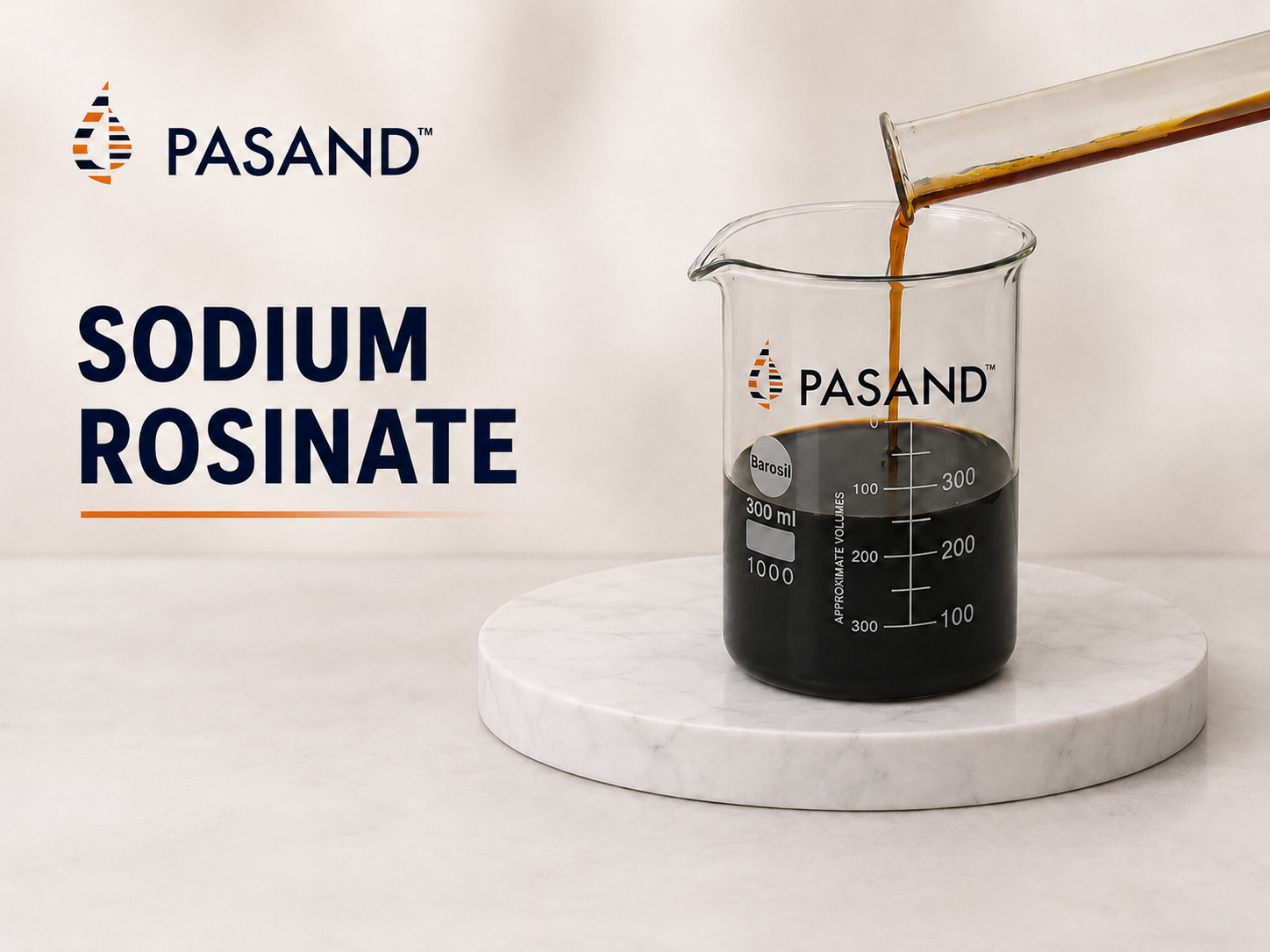
Pasand™ SRT100 is produced by the saponification of refined rosin acids (primarily abietic acid) with sodium hydroxide (NaOH). It is a complex mixture of diterpene acid salts. Due to the bulky, hydrophobic structure of the rosin molecule, it provides unique physical properties compared to linear fatty acid soaps.
Sodium Rosinate Details
Features And Benefits
- Inherits the natural adhesive properties of rosin, enhancing the "stickiness" of formulations.
- The unique tricyclic structure of the rosin acid skeleton provides superior stability for oil-in-water emulsions.
- Effectively generates small, stable air bubbles in cementitious mixtures.
- Often used in combinatio with fatty acid soaps (like Sodium Oleate) to provide a balance of cleaning and stabilizing properties.
- Derived from natural pine resin, making it an environmentally sustainable alternative to synthetic petroleum surfactants.
Application
- Used as a traditional internal sizing agent to improve the water resistance and ink-holdout properties of paper and paperboard.
- Used as an air-entraining agent in concrete and mortar to improve freeze-thaw resistance and workability.
- Acts as a primary emulsifier in the emulsion polymerization of Styrene-Butadiene Rubber (SBR) and Chloroprene Rubber.
- Utilized in the formulation of soluble cutting oils and degreasers where high surface activity is required.
- Used as an emulsifier to stabilize bitumen emulsions for road construction and roofing.
Specifications
|
|
Sodium Rosinate |
|
Appearance |
: Thick brown jelly type liquid |
|
Solid Content |
: 45 - 48 |
|
Specific Gravity |
: 1.04 - 1.06 |
|
pH Value |
: 8 - 9 |
|
Solubility in Water |
: Completely soluble |
|
Viscosity (B4 Cup) |
: 25-30 Sec |
Packing
Pasand™ SRT100 is packaged in 50KGS carboy or 200 KGS HDPE drums. Private labelling and customised packing is also available on request. Store in a dry, well-ventilated area. Keep container closed. Keep away from heat, sparks and flames.
Safety & Handling
Material must be handled as an Industrial chemical, wearing protective equipment and observing the precautions as mentioned in the MSDS